Guide to North Carolina Marriage Records
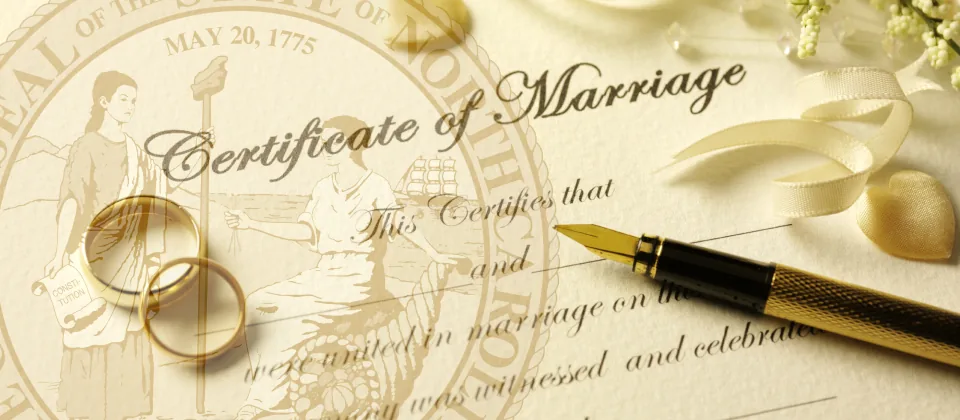
A North Carolina marriage record is the official documentation created when two people are legally joined in marriage in North Carolina. It includes basic information about the marriage: who married, when, and where it took place.
A marriage record is the overall name of any documentation regarding a marriage that is maintained by the county or state. It may be in the form of a marriage license or marriage certificate. A marriage license is an authorization issued to a couple, permitting them to marry. On the other hand, a marriage certificate is the official record created after the marriage officiant returns to the Register of Deeds, confirming the marriage took place.
Requests for North Carolina marriage records can be generally divided into the following categories:
- Legal matters: To prove marital status to qualify for benefits and insurance, obtain immigration approval, and participate in court proceedings.
- Genealogy and family history: To trace family connections.
- Name change: To update a Social Security card and driving license.
- Divorce or estate matters: To prove marital status in divorce and inheritance matters.
Types of Marriage Records in North Carolina
| Record Type | Purpose | Issued by | Validity / Notes |
|---|---|---|---|
| Marriage License | Official permit for a couple to marry. | County Register of Deeds. | Valid for 60 days. |
| Marriage Certificate | Legal proof that a marriage occurred. | Vital Records office or the county Register of Deeds. | Official proof of marriage for legal purposes. |
| Historical Marriage Records | Genealogical or family history research. | State archives of North Carolina and county Registers of Deeds. | Before 1868, marriage bonds were commonly used; beginning in 1868, North Carolina standardized marriage licenses. |
North Carolina marriage records generally come in the following forms:
Marriage Certificates
A marriage certificate serves as proof that a marriage has taken place and that the completed marriage information has been returned to the Register of Deeds, who issued the marriage license.
Generally, North Carolina marriage certificates include:
- Names of the couple involved
- Date of marriage
- Location of where the marriage occurred
- Details of the officiant
- Details of witnesses to the marriage
- Information identifying the marriage license or record
A certified copy of a North Carolina marriage certificate is required when an agency or organization needs official proof of the marriage, such as for certain name changes, benefits, immigration matters, or legal proceedings.
Certified copies of marriages from 1962 to date can be obtained from NC Vital Records or from the Register of Deeds in the county where the marriage took place.
Marriage Licenses
A marriage license gives the applicants legal permission to marry. Before a marriage takes place, state law requires that a marriage license be obtained.
A marriage license differs from a marriage certificate in that a marriage license authorizes the marriage ceremony, while the marriage certificate provides official confirmation that a marriage has taken place.
Marriage licenses can be obtained from a county Register of Deeds. In North Carolina, couples may obtain their marriage licenses from any county Register of Deeds within the state. Furthermore, they can use the marriage license to hold a wedding ceremony anywhere in North Carolina.
A North Carolina marriage license is valid for 60 days after issuance.
Marriage Record Verifications
Although the state does not offer a separate statewide marriage verification certificate or letter, Section 130A-93.1 of the North Carolina General Statutes authorizes the State Registrar to conduct a routine search of vital records files, even when no copy is issued.
While this search can be used to determine whether a marriage record is one, North Carolina does not establish it as a separate standardized marriage-verification document. It also does not specify a standard set of information that must appear on one.
Since the state vital records office only maintains marriage records from 1962 to the present, requests for records before that date should be directed to the Register of Deeds in the county where the marriage license was issued.
Are Marriage Records Public in North Carolina?
North Carolina marriage records are generally open to public inspection under the state Public Records Law. While anyone may inspect a county marriage certificate or request a copy or abstract, certified copies are limited to:
- Persons named in the record
- Certain relatives of the individuals named on the record
- Individuals seeking information for a legal determination of personal or property rights
- Authorized agents or legal representatives of the persons named on the record
Certain information, such as Social Security numbers, is not made publicly available even in uncertified marriage records.
What Information Is Included in a Marriage Record?

A typical North Carolina marriage record includes the following:
- Full names of spouses
- Date and place of marriage
- County of marriage
- Marriage license number
- Marriage officiant information
Although additional information is included in the initial marriage license application paperwork (such as ages, race, occupations, birthplaces, and parents' names), it is typically redacted from public inspection.
How to Find Marriage Records in North Carolina
Step 1: Identify the Marriage Details
Before you start a formal search, you need to collect the information needed about the marriage. Full names of both spouses, approximate year or date of marriage, and the North Carolina county where the marriage license was obtained must be identified.
Step 2: Find the Record Custodian
The correct custodian of a North Carolina marriage record depends on the date of the event:
- County Register of Deeds: For marriages occurring at any time from the county's inception to the present day, the county Register of Deeds office that issued the marriage license is the custodian of the record.
- State Vital Records Office: For all marriages occurring after January 1962, copies may be obtained from the state's centralized vital records office in Raleigh.
- North Carolina State Archives: For historical or ancestral marriages (before 1962) or marriage bonds between 1741 and 1868, records are available in the state archives or through special historical resources.
Step 3: Choose How to Search
You can perform a North Carolina marriage record search through the following channels:
- Online: Requesters may use official county portal lookups, the state vital records website, or approved vendors like VitalChek for modern records.
- By Mail: Requesters may also submit an application, along with the required processing fees and photocopies of identification, to the relevant county or state office.
- In Person: Visit the physical office of the county Register of Deeds during standard operational hours.
- Third-Party Databases: Searchers may access curated digital historical archives, such as FamilySearch and Ancestry, for genealogical indexing of North Carolina marriage records.
Step 4: Submit a Record Request
When submitting a request, the requester must provide valid government-issued photo identification (such as a driver's license or passport) if ordering a certified copy. They must complete the designated application form, pay the mandatory search or duplication fees, and wait out the designated processing time.
How to Get a Certified Marriage Certificate in North Carolina
North Carolina law restricts who can get a certified marriage certificate in the state. Eligible requesters include:
- A person named on the record
- The person's spouse
- Sibling
- Direct ancestor, such as a parent or grandparent
- Direct descendant, such as a child or grandchild
- Stepparent
- Stepchild
- A person seeking the record for a legal determination of personal or property rights
- An authorized agent, attorney, or legal representative of an eligible person
To obtain this record, applicants must provide a clear photocopy of a valid, unexpired government-issued picture ID. Accepted credentials include a state driver's license, a state-issued non-driver identification card, a military ID, or a passport. On the application, applicants must specify the full names of both spouses and the exact date of the wedding.
You can obtain a certified marriage certificate in North Carolina in the following ways:
- North Carolina Vital Records Office: The state maintains marriage certificates from 1962 to the present. The state search and first-copy fee is up to $24, and additional copies from the same search are $15 each.
- County Register of Deeds: Request the certificate from the county where the marriage took place. The statutory fee for a certified marriage copy is $10.
Depending on the office, requests may be submitted online, by mail, or in person. The North Carolina Vital Records publishes current state processing information on its processing dates page, while county offices can often issue certificates the same day. The average processing time for marriage certificates (1962-present) ordered from the state vital records office is 9 months.
Certified copies of a North Carolina marriage certificate can be used as official evidence of marriage for name changes, government identification, benefits, immigration matters, property matters, and other transactions requiring proof of marriage.
How to Get a Marriage License in North Carolina
In the State of North Carolina, to obtain a marriage license, couples must apply to any county Register of Deeds office. For the application to be considered, applicants must meet certain eligibility conditions.
As stated under G.S. § 51-8, marriage license applicants must be 18 or older. However, applicants aged 16 and 17 may apply for a marriage license only with their parents’ or guardians’ written consent, while those aged 14 and 15 must provide a special district court order. No applicant below the age of 14 may be authorized to marry.
During the application, applicants must present their Social Security card, W-2 form, or a detailed payroll stub. If the applicant does not have an SSN, a certified affidavit may have to be submitted instead. North Carolina does not require marriage license applicants to reside in the state to be eligible.
The cost of obtaining a marriage license in North Carolina is $60. No waiting period is required after obtaining the license, but the license is only valid for 60 days.
In North Carolina, marriages must be conducted by an individual authorized by state law, such as a minister, recognized magistrate, or civic leader. Moreover, the marriage must take place in the presence of at least two competent witnesses, who must also sign the marriage certificate.
Who Can Request Marriage Records?
Anyone may generally inspect a marriage certificate maintained by a county Register of Deeds or request a copy or abstract. However, certified copies are limited to eligible individuals, such as:
- Either spouse
- Siblings
- Parents and grandparents
- Children and grandchildren
- Stepparents and stepchildren
- People seeking information for a legal determination of personal or property rights
- Authorized agents
- Attorneys
- Legal representatives
Free and Online Marriage Record Searches

North Carolina does not offer a statewide public search of marriage certificates. However, some counties provide access to free online search tools on their official Register of Deeds websites for users to access marriage records created in their jurisdictions.
These public access indexes enable individuals to find both old and recent marriage records by first and last name. The information available for free on these platforms includes the couple's names, the date of marriage, and the certificate reference number.
For historical marriage records, requesters can use services such as FamilySearch and state archives. The State Archives of North Carolina offers a good source of indexed historical marriage announcements.
If you are unsure about the exact date or date of a historical marriage, you may use the statewide index databases on Ancestry.com or FamilySearch.com. Another option is to search neighboring counties or look for references to the marriage in alternative historical documents, such as property deeds, census records, or obituaries.
Common Law Marriage in North Carolina
North Carolina does not recognize common law marriages. Hence, no matter how long couples live together, share a residence, or present themselves publicly as spouses, North Carolina law does not recognize their marriage without a valid license and ceremony.
On the other hand, North Carolina adheres to the “Full Faith and Credit” provision of the United States Constitution. Therefore, if a couple has a valid, legally binding common-law marriage recognized in another state, North Carolina will recognize it when they come to the Tar Heel State.
Since common-law marriages are not recognized in North Carolina, the state does not maintain public records for domestic common-law unions.
How to Correct an Error on a Marriage Record
In line with Section 51-18.1 of the North Carolina General Statutes, the Register of Deeds is allowed to amend errors in marriage applications, licenses, or certificates, provided relevant and valid documentation is submitted by an eligible requester. The state considers the spouses named on the record as eligible requesters.
Some of the common mistakes that require correction include misspelled names, incorrect ages or dates, incorrect residence information, and incorrect parental information.
Marriage record amendment applicants are required to complete a formal amendment application and provide evidence of the error. Proofs should include a copy of the official government-issued document reflecting accurate information. These may be a certified copy of a birth certificate, a valid Social Security card, or a valid passport. Per G.S. § 161-10, the statutory fee to correct a marriage record is $10, which includes the cost for one certified copy of the amended record.
Marriage Records and Name Changes
A valid marriage certificate can serve as proof of a legal name change after marriage. Agencies, including the Social Security Administration and the North Carolina DMV, may require this document to verify that an individual has had a marriage-based name change.
Name changes and amendments to marriage records are different. The certified marriage certificate itself does not change any official record; it only acts as proof for agencies to update their records.
Marriage Records for Genealogy and Family History
People researching family histories find North Carolina marriage records valuable. These records are maintained by the State Archives of North Carolina and are typically available as microfilm and digital records dating back to colonial times. Before the standard county license laws were enacted in 1868, North Carolina used a system of marriage bonds (spanning from 1741 to 1868). These records are indexed and available to researchers.
While searching historical North Carolina marriage records, be aware that spelling variations are common. It may be helpful to search using a wildcard or search for names that sound similar.
Furthermore, older marriage records may be incomplete. When official marriage records are missing, genealogists may find other proofs of marriage in church records, family bibles, local newspapers, and historical records of land transfer deeds.
Frequently Asked Questions
Are marriage records public in North Carolina?
Yes. North Carolina marriage records are open to public inspection. While uncertified copies are considered public records, certified copies can only be obtained by the spouses or individuals directly related to them.
How can I find a marriage record by name?
You can search the Register of Deeds records for the county in which the marriage took place. For any marriage that took place after 1962, you may request those records from the North Carolina Vital Records office.
Can I search marriage records online for free?
While some county Registers of Deeds permit free access to their online indexing or marriage record search tools, the North Carolina Vital Records does not provide a free searchable database of marriage records. You may also search historical records online at no cost on websites like FamilySearch or the State Archives of North Carolina.
How much does a marriage certificate cost?
The state charges $10 for a certified copy of a marriage record obtained from a county Register of Deeds. For a request made via the North Carolina Vital Records office, the fee is $24 for the first copy or routine search, while each additional certificate from the same search costs $15.
How long does it take to get a certified marriage certificate?
If you are applying in person at the Register of Deeds office, you may receive your marriage certificate on the same day. However, if you apply online through the state vital records office, it may take several months for your application to be processed.
Can someone else request my marriage certificate?
Anyone is entitled to request an uncertified copy of your marriage certificate. However, only close relatives or authorized representatives are allowed to apply for obtaining certified marriage certificates.
What is the difference between a marriage license and certificate?
A marriage license authorizes the individuals named on it to marry and is obtained before the marriage ceremony. A marriage certificate records that the marriage ceremony was performed.
Table of Contents
- Types of Marriage Records in North Carolina
- Are Marriage Records Public in North Carolina?
- What Information Is Included in a Marriage Record?
- How to Find Marriage Records in North Carolina
- How to Get a Certified Marriage Certificate in North Carolina
- How to Get a Marriage License in North Carolina
- Who Can Request Marriage Records?
- Free and Online Marriage Record Searches
- Common Law Marriage in North Carolina
- How to Correct an Error on a Marriage Record
- Marriage Records and Name Changes
- Marriage Records for Genealogy and Family History
- Frequently Asked Questions